




MONOLITHIC BREATHABLE MEMBRANE FOR ROOFS AND WALLS TRASPIR EVO 160
Breathable roof membrane with monolithic film for every construction system
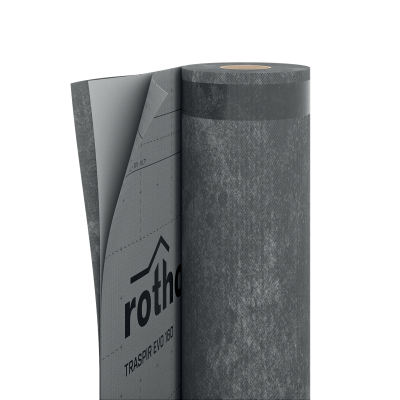
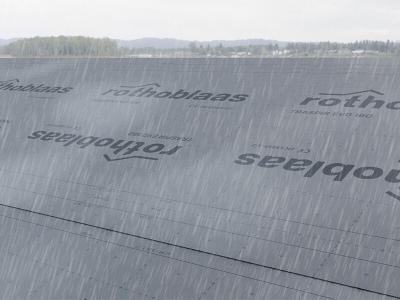
TRASPIR EVO 160 is the monolithic breathable membrane for waterproofing and airtightness in timber, steel and masonry roofs and walls. As a waterproof breathable membrane roof, it combines vapour permeability and watertightness in a single functional layer: the extruded elastomeric film between two polypropylene non-woven layers ensures long-term durability, even during prolonged exposure on site. Installable on the internal and external side of the roof assembly. Reaction to fire class B-s1,d2 (EN 13501-1). Watertightness class W1 (EN 1928). Certified to EN 13859-1/2.
Available in 1.5 m and 3.0 m widths, including a TT version with integrated double tape

TRASPIR EVO 160 breathable roof membrane: composition and performance
TRASPIR EVO 160 is a waterproof breathable membrane roof with a monolithic film, Sd value of 0.1 m (EN 1931), 160 g/m² mass per unit area and 0.5 mm thickness. The monolithic structure avoids mechanical stress during manufacturing, keeping the film elastic and resistant to pollutants over time. Self-extinguishing membrane (class B-s1, d2), which does not spread the flame in case of fire contributing to the protection of the structure.
Key technical specifications (EN 13859-1/2):
— Water vapour permeability Sd: 0.1 m (34 US Perm)
— Tensile strength MD/CD: 280/220 N/50 mm
— Resistance to nail tearing MD/CD: 180/200 N
— Watertightness: class W1 · Water column > 500 cm (ISO 811)
— Reaction to fire: class B-s1,d2 (EN 13501-1)
— UV stability: 1000 h (EN 13859-1/2) · Low-temperature flexibility: -40°C
— Temperature resistance: -40°C/100°C · Air permeability: < 0.02 m³/(m²h50Pa)
Tested to ASTM E331 at 300 Pa: no ingress. Artificial ageing of 5000 h UV at 50°C + 90 days at 70°C (MEZeroE project): watertightness class W1 maintained. EPD available.
Monolithic breathable membrane for timber roofs: why choose it over a microporous membrane?
A monolithic membrane transfers water vapour through its hydrophilic polymer chain, without micropores. It is not subjected to mechanical stress during manufacturing and maintains both watertightness and vapour permeability even when exposed to pollutants. Microporous membranes, made from hydrophobic polymers, are more sensitive to chemical agents and UV degradation over time.
Breathable roof membrane: monolithic or microporous?
Monolithic membranes are affected by only one source of stress – UV radiation – whereas microporous membranes also suffer the mechanical stress of the manufacturing process, making them stiffer and more susceptible to degradation.
TRASPIR EVO 160 passed 1000 hours of UV ageing while maintaining class W1 watertightness and a tensile strength of 260/200 N/50 mm after testing (EN 1297/EN 12311-1).
Waterproof breathable membrane roof with B-s1,d2 reaction to fire: what does it mean?
The B-s1,d2 classification means that the membrane does not promote flame spread (B), produces only a limited amount of smoke (s1), and does not generate flaming droplets during a fire (d2). It is one of the highest classifications defined by EN 13501-1 for flexible membranes. TRASPIR EVO 160 has also been tested to NFPA 285 and ASTM E84 (Class 1/Class A) for North American markets.
Documents
-
Technical data sheets
- Technical data sheets Croatian
- Technical data sheets Czech
- Technical data sheets English
- Technical data sheets French
- Technical data sheets German
- Technical data sheets Greek
- Technical data sheets Hungarian
- Technical data sheets Italian
- Technical data sheets Polish
- Technical data sheets Portuguese
- Technical data sheets Romanian
- Technical data sheets Russian
- Technical data sheets Slovenian
- Technical data sheets Spanish
-
Xml-File WUFI
-
Recommendations for installation
-
Environmental Product Declaration (EPD)
-
TEST REPORT USA-CA
Technical Data
| Property | Standard | Tested Values | USC Conversion |
|---|---|---|---|
| Mass per unit area | EN 1849-2 | 160 g/m² | 0.52 oz/ft² |
| Thickness | EN 1849-2 | 0,5 mm | 20 mil |
| Water vapour transmission (Sd) | EN 1931 | 0,1 m | 34.965 US perm |
| Water vapour transmission (dry cup) | ASTM E96/ E96M | 12.3 US perm | - |
| Water vapour transmission (dry cup) | ASTM E96/ E96M | 702 ng/(s·m²·Pa) | - |
| Tensile strength MD/CD | EN 12311-1 | 280 / 220 N/50mm | 32 / 25 lbf/in |
| Elongation MD/CD | EN 12311-1 | 50 / 60 % | - |
| Resistance to nail tearing MD/CD | EN 12310-1 | 180 / 200 N | 40 / 45 lbf |
| Watertightness | EN 1928 | class W1 | - |
| Resistance to temperature | - | -40 / 100 °C | -40 / 212 °F |
| Reaction to fire | EN 13501-1 | class B-s1,d2 | - |
| Resistance to penetration of air | EN 12114 | < 0,02 m³/(m²·h·50Pa) | < 0.001 cfm/ft² at 50Pa |
| Thermal conductivity (λ) | - | 0,4 W/(m·K) | 0.23 BTU/(h·ft·°F) |
| Specific heat | - | 1800 J/(kg·K) | - |
| Density | - | ca. 370 kg/m³ | - |
| Water vapour resistance factor (μ) | - | ca. 160 | - |
| Joint strength | EN 12317-2 | > 200 / N/50mm | > 22.840589 / lb/in |
| Resistance to water penetration at 300Pa on wall | ASTM E331 | - | - |
Composition
| TOP LAYER | non-woven PP fabric |
|---|---|
| middle layer | breathable monolithic PE film |
| BOTTOM LAYER | non-woven PP fabric |
Product specifications
TRASPIR EVO 160
Supply and installation of monolithic breathable membrane, like TRASPIR EVO 160.
Composition
From top layer to bottom layer:
non-woven PP fabric;
breathable monolithic film;
non-woven PP fabric.
Properties
Mass per unit area [g/m²]: 160
Thickness [mm]: 0,5
Water vapour transmission (Sd)[m]: 0,1
Tensile strength MD/CD [N/50 mm]: 280/220
Elongation MD/CD [%]: 50/60
Resistance to nail tearing MD/CD [N]: 180/200
Watertightness: class W1 (EN 1928)
Reaction to fire: class B-s1, d2 (EN 13501-1)
Resistance to temperature [C°]: -40/100
UV stability: 1000h (8 months)
VOC [%]: not applicable
Standards and certifications
CE marked in accordance with EN 13859-1/2
LCA
EPD
ASTM E84 Class 1 - Class A
AUS 4200.1 Class 4
Description
The application surface must be dry, free of dust and grease. Surface elements must be removed so that the membrane is not damaged during application.
Recommended use: direct UV protection is guaranteed. Installation is therefore permitted on both the internal and external sides of the building envelope.
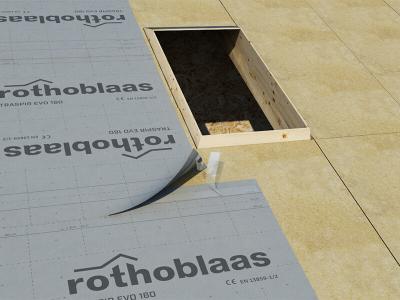
Installation: Unroll the membrane. If the version without double-sided adhesive strips is used, sealing must be carried out using tape such as: FLEXY BAND, FLEXY BAND UV, SPEEDY BAND, or EASY BAND.
Installation in compliance with the B-s1, d2 value: Unroll the membrane and seal using tape with fire resistance characteristics similar to those of the membrane.
Ensure that the overlap between the membranes is at least 15 cm to achieve an optimal seal.
To ensure correct and professional installation, the use of a nail sealing point is required.
Further details regarding installation can be found in the specific instructions provided by the supplier.