

HIGH-PERFORMANCE FLOOR SOUNDPROOFING MADE FROM RECYCLED POLYMERS SILENT FLOOR PUR
Floor sound insulation for timber, steel and masonry floors with maximum acoustic performance
SILENT FLOOR PUR is the high-performance soundproofing solution in the SILENT FLOOR range. Its polyurethane compound, manufactured from pre-consumer industrial waste, maintains its elasticity over time without sagging, achieving impact sound reduction values of over 30 dB. Available in three thicknesses: 10, 15 and 20 mm.
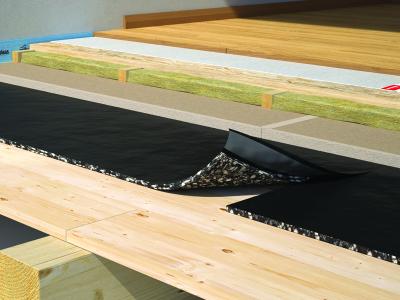
Installed beneath the screed, it improves the acoustic performance of finished floor systems on timber, steel and masonry structures. When combined with resilient profiles, it effectively reduces structure-borne noise. Supplied in strips, it can be used as acoustic insulation for the refurbishment of vertical partitions when installed in framed double walls.

Technical specifications of the best sound insulation for floors: SILENT FLOOR PUR
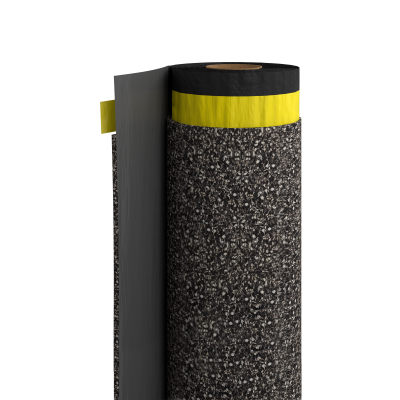
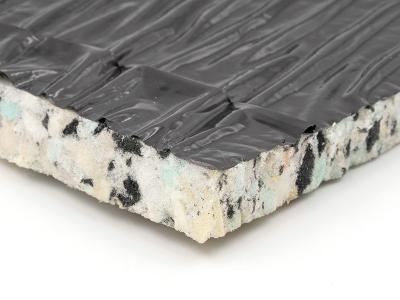
SILENT FLOOR PUR consists of recycled polyurethane agglomerate made from pre-consumer industrial waste, bonded to a polyethylene vapour barrier with integrated adhesive strip.
It is both recycled and recyclable, contains no substances harmful to people or the environment, and is certified VOC A+ for emissions. The polyurethane maintains its elasticity over time without sagging or loss of performance.
Key technical features (20 mm thickness):
— Impact sound reduction ΔLw: 25 dB (ISO 10140-3)
— Theoretical ΔLw estimate: 35.7 dB (ISO 12354-2, m'=125 kg/m²)
— Dynamic stiffness s': 7.4 MN/m³ (EN 29052-1)
— Compressibility class: CP2 (EN 12431)
— Water vapour permeability Sd: >100 m
— Thermal conductivity λ: 0.035 W/m·K
— VOC emissions classification: A+ (French Decree No. 2011-321)
— Available thicknesses: 10 mm (ΔLw 21 dB) · 15 mm (ΔLw 23 dB) · 20 mm (ΔLw 25 dB)
Which floor sound insulation should you choose based on thickness and version?
SILENT FLOOR PUR is available in three thicknesses with progressively lower dynamic stiffness: 10 mm (ΔLw 32.5 dB) · 15 mm (ΔLw 34.6 dB) · 20 mm (ΔLw 35.7 dB), according to ISO 12354-2 with m'=125 kg/m².
The lower the dynamic stiffness, the greater the acoustic attenuation. The appropriate thickness should be selected according to the screed and required performance. All three versions include an integrated adhesive strip and vapour barrier, eliminating the need for a separate layer.
Why is SILENT FLOOR PUR the best sound insulation for floors on CLT floor slabs?
On a 200 mm CLT floor slab with a 50 mm screed, the 20 mm SILENT FLOOR PUR achieved ΔIIC = +25 and ΔLn,w = -25 dB (Building Physics Lab, Free University of Bozen-Bolzano, ISO 10140-3). On a timber frame floor with 80 mm sand-cement screed, it achieved IIC = 69 and ΔLn,w = -27 dB (CSI, ISO 10140-3).
Testing carried out by the University of Northern British Columbia demonstrated an AIIC improvement of 20 to 27 dB depending on screed thickness (38–100 mm) on a 139 mm CLT floor slab. When integrated with XYLOFON resilient profiles and TITAN SILENT fastening systems, the assembly optimises the reduction of flanking sound transmission.
Can SILENT FLOOR PUR be used as acoustic insulation for double walls?
Yes. Supplied in 10 mm strips, SILENT FLOOR PUR has been tested as a decoupling element for timber frame walls, achieving improvements in ΔRw of up to +14 dB and ΔSTC up to +13 (Building Physics Lab, Free University of Bozen-Bolzano, ISO 10140-2).
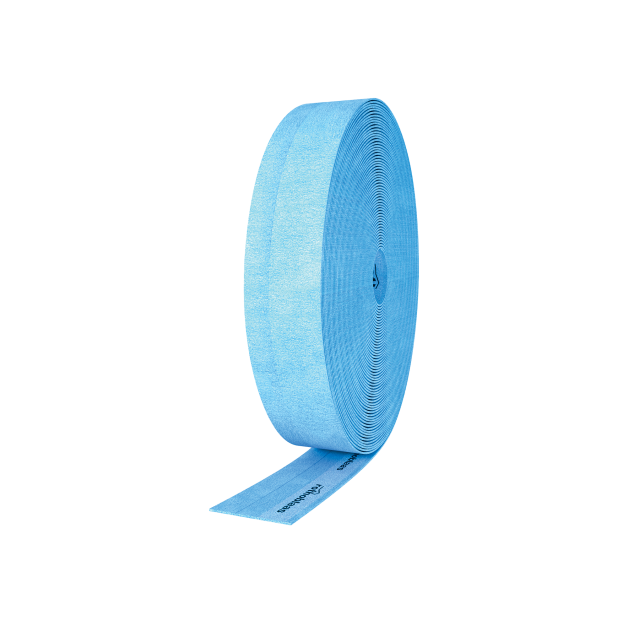
Its use in double walls — on plasterboard or gypsum fibre boards — has been documented in eight different timber frame wall configurations, with and without SILENT WALL BYTUM SA as an additional layer. The SILENT EDGE perimeter strip should be used around the entire perimeter to prevent acoustic bridging.
Documents
-
Technical data sheets
-
Technical Manual
SILENT FLOOR PUR
| CODE | H
[m]
|
L
[m]
|
s
[mm]
|
A
[m²]
|
pcs./pallet |
|---|---|---|---|---|---|
| SILFLOORPUR10 | 1.6 | 10 | 10 | 16 | 6 |
| SILFLOORPUR15 | 1.6 | 8 | 15 | 12.8 | 6 |
| SILFLOORPUR20 | 1.6 | 6 | 20 | 9.6 | 6 |
Product specifications
SILENT FLOOR PUR
Supply and installation of high-performance resilient underscreed foil made from recycled polymers, Type SILENT FLOOR PUR.
Composition
From top layer to bottom layer:
- polyethylene vapour barrier;
-polyurethane agglomerate made from pre-consumer industrial waste.
Properties
-
Resistance to airflow r [kPa·s·m^-2]: < 10,0
-
Compressibility class: CP2
-
CREEP Viscous sliding under compression Xct (1,5 kPa)[%]: 7,5
-Compression deformation stress [kPa]: 17
-
Thermal conductivity λ [W/(m·K)]: 0,035
-
Specific heat c [J/kg·K]: 1800
-
Water vapour transmission Sd [m]: > 100
-
Reaction to fire (EN 13501-1): class F
-
VOC emission classification: A+
-
Surface mass m [kg/m^2]: 0,9 ÷ 1,8
-
Density ρ [kg/m^3]: 80 ÷ 90
-
Apparent dynamic stiffness s’t [MN/m^3]: 7,4 ÷ 12,5
-
Dynamic stiffness s’ [MN/m^³]: 7,4 ÷ 12,5
-
Theoretical estimate of impact sound pressure level reduction ΔLw [dB]: 32,5 ÷ 35,7
-System resonance frequency f0 [Hz]: 38,9 ÷ 50,6
-
Impact sound pressure level attenuation ΔLw [dB]: 21 ÷ 25
-
Thermal resistance Rt [m^2K/W]: 0,46 ÷ 0,92
Description
Resilient underscreed foil used to enhance impact noise insulation and increase the overall soundproofing performance of the finished floor slab. -This is a waterproof membrane coupled with a resilient component made from recycled latex and foam rubber.
The impact sound insulation system is composed of these two elements, with an integrated adhesive flap to simplify overlapping between rolls.
The product is recyclable, rot-proof, insoluble in water, and non-irritating to skin, eyes, or respiratory system.
Installation is made easier by the integrated adhesive band, allowing immediate attaching of the selvedges to the overlaps.
Installation
It is typically used in new constructions, following the design and application principles of the “floating screed” system.
The resilient layer must be continuous because any discontinuation would represent an acoustic bridge.
It is important to use a perimeter strip to ensure that the resilient layer is continuous around the entire perimeter of the room. The perimeter strip should only be trimmed after the floor has been installed and grouted.
The system must be installed in accordance with the instructions and warnings provided by the manufacturer to ensure compliance and long-term performance.